When you buy through links on our site , we may make an affiliate commission . Here ’s how it works .
update at 3:02 p.m. ET .
2016 was the hottest twelvemonth on Earth since record safekeeping start more than 130 class ago , and human being are mostly to blame , scientists reported today ( Jan. 18 ) .
The globally averaged temperature over land and ocean surfaces for 2016 was the highest among all years since record keeping began in 1880.
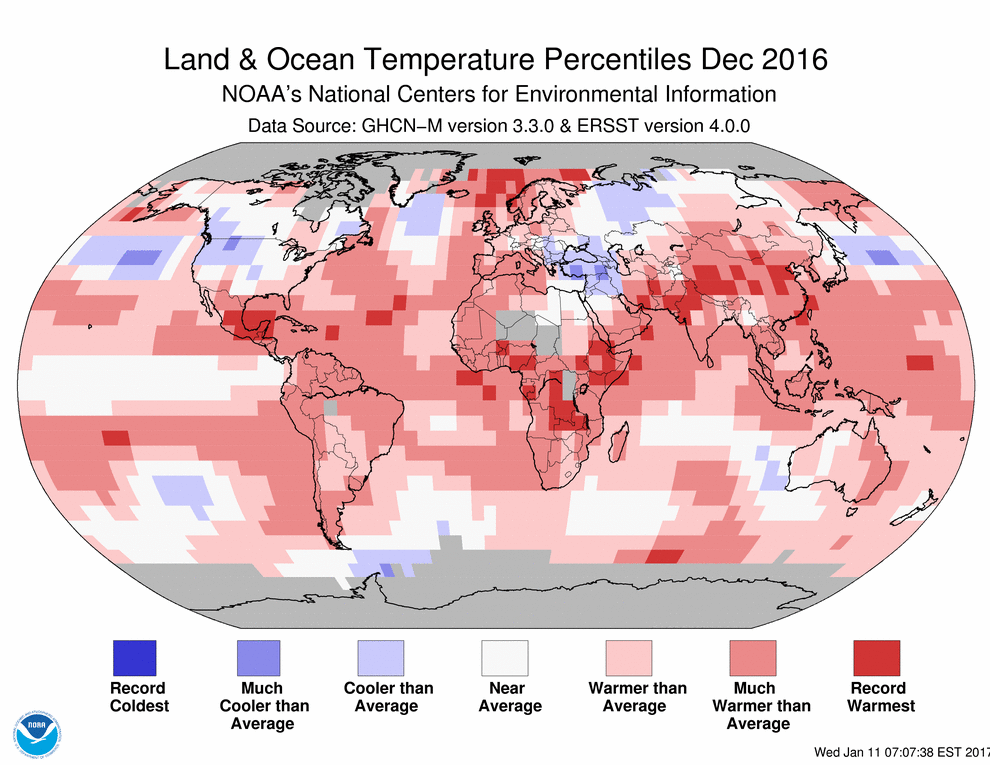
Last yr ’s middling temperature over land and ocean surface were the highest ever seen since 1880 , and were 1.69 degrees Fahrenheit ( 0.94 degrees Celsius ) above the 20th - one C norm , agree to scientist from the National Oceanic and Atmospheric Administration ( NOAA ) . Across the planet , there was not a undivided nation area that experienced lower - than - average temperature for the class , they order .
In fact , 2016 score the third consecutive record - warm class for the globe . Every month from January through August became the warm such month on record book , according to NOAA . Moreover , the 16 successive month from May 2015 to August 2016 either break or tie the previous record for that month , the researchers said .
" This was the third year in a course in our depth psychology to set a new record , " Deke Arndt , chief of the global monitoring branch at NOAA ’s National Centers for Environmental Information in Asheville , North Carolina , told reporters today . " That happen only once before in our disk , and that was in the years 1939 through 1941 , which now do n’t even fit in the top 30 [ hottest yr ] of the record book . " [ The Year in Climate Change : 2016 ’s Most Depressing Stories ]

The annual temperature cycle from 1880 to 2016.
The rod are also feeling the heat . An estimation of the average annual ocean - ice extent in 2016 in the Arctic was the gloomy one-year norm on record : 3.92 million substantial miles ( 10.1 million square kilometers),according to the National Snow and Ice Data Center .
" you’re able to see 2016 sure enough scraped the bottom of this record , and at metre , especially during the Northern Hemisphere ’s bounce months and in the last two - and - a - one-half months of the yr , define new records for small ocean - glass extent , " Arndt say .
Meanwhile , the Arctic was almost 7.2 degrees F ( 4 degrees C ) ardent in 2016 than it was in preindustrial times , said Gavin Schmidt , director ofNASA ’s Goddard Institute for Space Studies . " That ’s really a very expectant variety , " he said .

Six different datasets showing the climate change warming trend over time.
The El Niño(a clime cycle characterized by unco warm temperatures in the equatorial Pacific Ocean ) that spanned 2015 and 2016 add to the warmer temperature , but the vast majority of the thawing — 90 percentage — was due to human action , mainly throughthe emission of greenhouse gases , Schmidt said .
The investigator noted that they used global climate good example to determine how different factor — include the natural impacts of volcanoes , solar changes and variation in Earth ’s compass , as well as human - related impacts , such as greenhouse gasoline — impart to climate alteration .
" We encounter the private fingerprints for all of those dissimilar things , " Schmidt said . " And then we look at all of the datum Seth — not just thesurface air temperatures , but the information sets from the upper atmosphere and stratosphere and the deep ocean . "

Thesemodels show that over time , the natural - part donation to the record passion " is very penny-pinching to zero , " Schmidt enounce . " jolly much all of the farseeing - condition trend that you ’re catch is the solution of human body process , and the prevalent part of that is the increment in glasshouse gaseous state , particularly carbon dioxide . "
In addition to looking at NASA and NOAA data , the researchers analyzed planetary temperature data bent from three other author : the United Kingdom ’s Met Office ; an adaptation of the Met Office ’s data set from research worker Kevin Cowtan , a chemist at the University of York , and Robert Way , a doctoral student of geography at the University of Ottawa ; and temperature information from the California - based sovereign non-profit-making establishment Berkeley Earth . [ Earth in the Balance : 7 Crucial Tipping Points ]
The analyses have slim difference from year to twelvemonth , but " they are capturing the same long - full term signal " that the satellite is warming rapidly , Arndt said . " I like to say that these information sets are all singe the same song , even if they ’re bump off different note along the way , " Arndt noted . " The pattern is very clear . "

The researchers declined to say whether the newly release data had a takeaway for the incoming administration of President - elect Donald Trump , who remove government agency this Friday ( Jan. 20 ) .
" We provide these assessments and these psychoanalysis for the welfare of the American people , " Arndt said . " Our mission is strictly to describe thestate of the climateand our methods on how we got there . "
Original article onLive Science .


