When you purchase through radio link on our site , we may earn an affiliate military commission . Here ’s how it works .
The annihilating neurodegenerative condition Alzheimer ’s disease is incurable , but with early sleuthing , patients can seek treatment to slow down the disease ’s onward motion , before some major symptoms appear . Now , by apply contrived intelligence algorithmic rule to MRI mastermind scan , investigator have developed a way to mechanically distinguish between patients with Alzheimer ’s and two early forms of dementia that can be precursor to the memory - robbing disease .
The researchers , from the VU University Medical Center in Amsterdam , suggest the glide path could finally allow machine-controlled cover and assisted diagnosis ofvarious mannequin of dementia , particularly in centers that lack experienced neuroradiologists .

Discrimination maps for classifying mild cognitive impairment (MCI) subgroups, inside the masks that resulted in the highest accuracies. A: between patients with MCI that converted to Alzheimer’s disease (MCIc) and subjects with subjective cognitive decline (SCD); B: between MCIc and patients with MCI that remained stable (MCIs).
to boot , the resultant , publish online July 6 in thejournal Radiology , show that the new system was able to relegate the form of dementia that affected role were have from , using antecedently unobserved scan , with up to 90 percent accuracy . [ 10 Things You Did n’t Know About the mentality ]
" The potential difference is the possibility of screen with these techniques so people at risk can beintercepted before the disease becomes evident , " suppose Alle Meije Wink , a older investigator in the center ’s radiology and nuclear medicine department .
" I think very few patients at the moment will trust an outcome predicted by a machine , " Wink told Live Science . " What I ideate is a Dr. commence a new scan , and as it is loaded , software would be able to say with a sure amount of self-assurance [ that ] this is die to be an Alzheimer ’s patient role or [ someone with ] another form of dementia . "
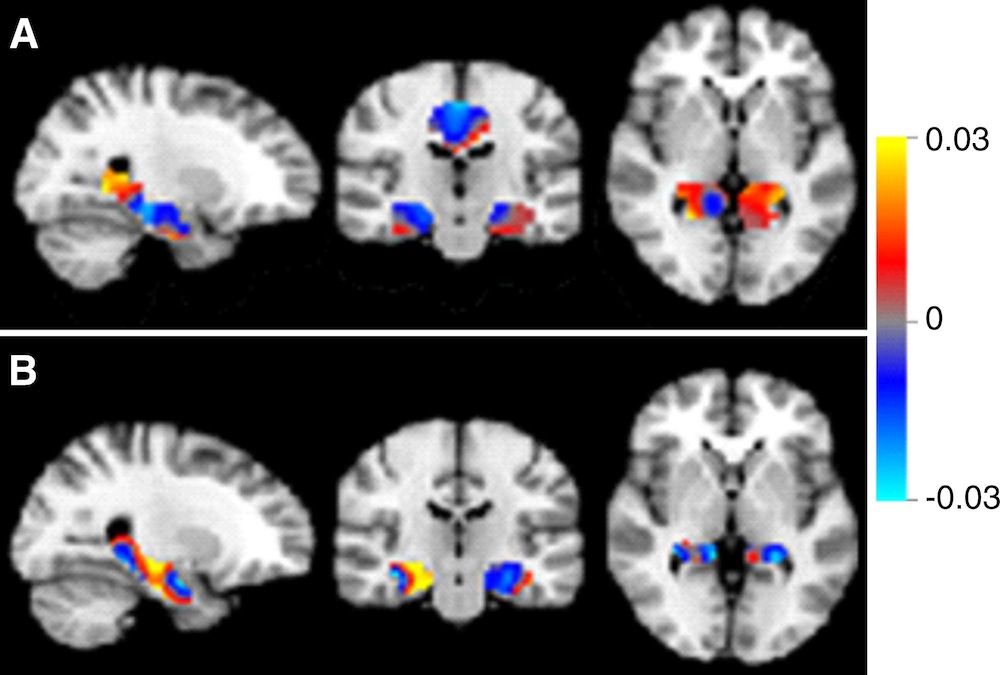
Discrimination maps for classifying mild cognitive impairment (MCI) subgroups, inside the masks that resulted in the highest accuracies. A: between patients with MCI that converted to Alzheimer’s disease (MCIc) and subjects with subjective cognitive decline (SCD); B: between MCIc and patients with MCI that remained stable (MCIs).
Detection methods
Similar motorcar - discover technique have already been used to detectAlzheimer ’s disease ; in those execution , the techniques were used on geomorphological MRI scans of the mentality that can show tissue paper loss colligate with the disease .
But scientist have long bang that the brain undergo functional change before these structural changes give up in , Wink said . Positron emission tomography ( PET ) imagery has been apopular method for tracking functional change , but it is incursive and expensive , he added .
Instead , Wink and his colleagues used an MRI technique call arterial spin labeling ( ASL ) , which measures perfusion — the process of blood being absorbed into a tissue — across the brain . The method acting is still experimental , but it is noninvasive and applicable on modern MRI scanner .
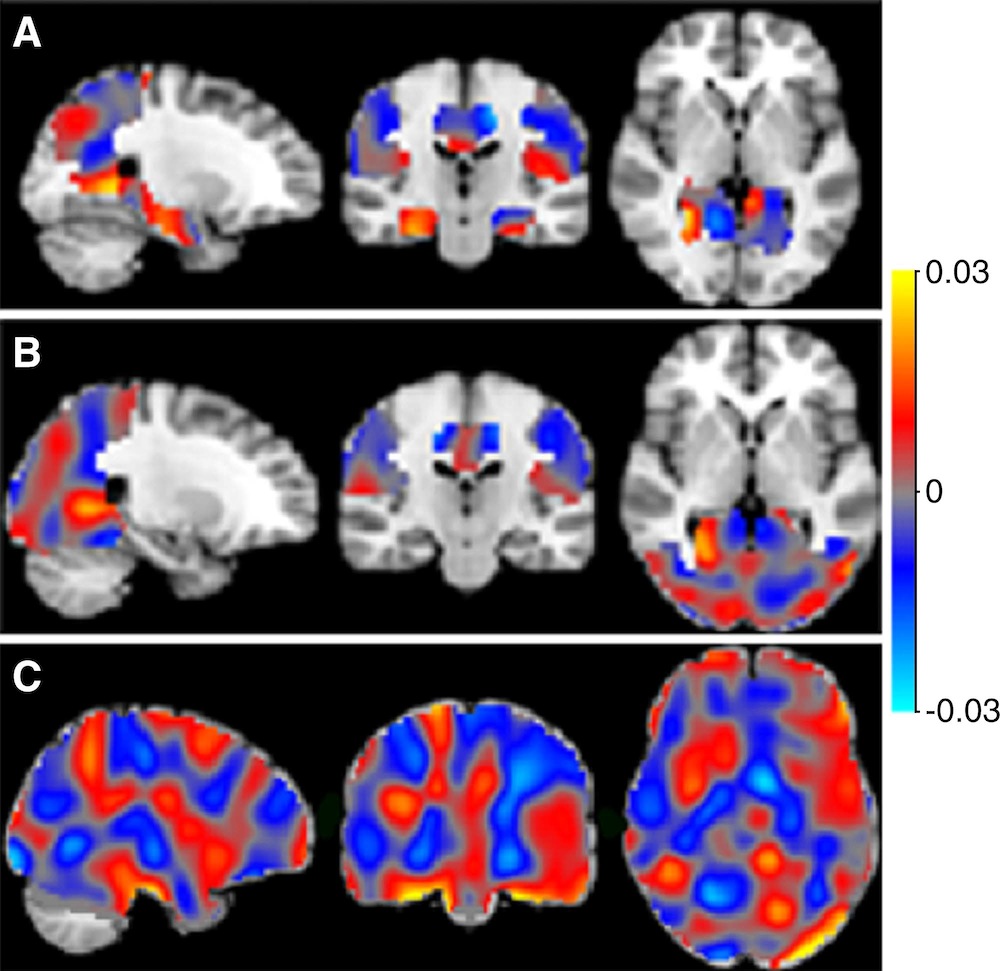
In these brain scans, the classifiers can be represented as discrimination maps, where a red color indicates that the intensity at that location contributes to the likelihood of the images belonging to the more advanced stage, and a blue color to the likelihood of belonging to the less advanced stage.
former study have shown that people with Alzheimer ’s typically video display diminish perfusion ( or hypoperfusion ) in brain tissue paper , which results in deficient supplying of O and nutrient to the mentality .
Training the system
Using so - call perfusion single-valued function from patient role at the medical heart and soul , Wink ’s squad trained its system to mark among patients who had Alzheimer’s , mild cognitive impairment(MCI ) and immanent cognitive descent ( SCD ) .
The wit CAT scan of half of the 260 participant were used to direct the organisation , and the other one-half were then used to test if the system could pick out among different conditions when looking at previously unseenMRI scans .
The researchers discovered that their approach could distinguish between Alzheimer ’s and SCD with 90 percentage truth , and between Alzheimer ’s and MCI with 82 percent accuracy . However , the system was circumstantially poor at distinguishing between MCI and SCD , accomplish an truth of only 60 percent , the researchers come up . [ 10 Ways to Keep Your Mind Sharp ]

Tantalizingly , preliminary results suggest the approach path may be capable to distinguish between cases of MCI that go on to Alzheimer ’s and those that do n’t , the research worker said .
In the report , there were only 24 MCI cases with follow - up data to indicate whether each patient ’s shape progressed to Alzheimer ’s , with 12 in each class . Therefore , splitting them into two groups — one to train the system and another to try out its ability to relegate the condition in unobserved scans — was not feasible , the investigator say .
In a preliminary analysis the arrangement was trained on all 24 casing leading to training truth of around 80 percentage when classifying these groups and separating them from the other main groups .

But without a separate prediction group , it was impossible to test the system on unseen scans , the research worker said . Combined with the small sample size in the subject , Wink said , it is too early to draw any firm decision , though the preliminary upshot are encouraging .
Real-world applications
Ender Konukoglu , an adjunct prof of biomedical image computing at ETH - Zurich , a scientific discipline and engineering university in Switzerland , pronounce conflate machine eruditeness and ASL is novel and could have significant clinical applications , but more needs to be done to formalise the approach .
The most worthful diligence is the ability to differentiate between MCI cases that progress to Alzheimer ’s and those that do n’t , but the sampling size in this study is too modest to appraise the reliability for such use , he tell . " big age bracket might show that ASL mental imagery coalesce with car learning is able to classify the MCI grouping , but until then , it is difficult to talk about the clinical applicability of the method presented here , ” Konukoglu told Live Science .
Wink agreed that one way to ameliorate accuracy would be to apply heavy data sets . But the glide slope his group is form on is creatingmachine - learning techniquesthat can use a broad variety of datum from unlike imaging gadget , he enunciate .

Christian Salvatore , a investigator at the Institute of Molecular Bioimaging and Physiology of the Italian National Research Council , pronounce the research is innovative but does n’t enter any young technique . It is simply an software of a well - known car - determine toolbox for neuroimaging analysis to ASL , he said .
But the categorisation functioning are good , Salvatore said , and the plan of attack also help describe brain regions of interestingness to doctors when diagnose these condition . This is something many research worker using machine encyclopaedism for neuroimage analysis neglectfulness , he enounce .
" clinician require to ' see ' results — they do n’t trust a black box that only returns the betoken recording label for a patient , " he assure Live Science . " So , single-valued function of the most significant voxels [ 3D pixels ] for assortment are quite necessary . "

Original article onLive Science .